1. The world is a dangerous place to live — not because of the people who are evil but because of the people who don't do anything about it. — Albert Einstein

2. The quickest way of ending a war is to lose it. — George Orwell

3. History teaches that war begins when governments believe the price of aggression is cheap. — Ronald Reagan

4. The terror most people are concerned with is the IRS. — Malcolm Forbes

5. There is nothing so incompetent, ineffective, arrogant, expensive, and wasteful as an unreasonable, unaccountable, and unrepentant government monopoly. — A Patriot

6. Visualize World Peace — Through Firepower!

7. Nothing says sincerity like a Carrier Strike Group and a U.S. Marine Air-Ground Task Force.

8. One cannot be reasoned out of a position that he has not first been reasoned into.

Showing posts with label market medicine. Show all posts

2013-12-22

How Obamacare Actually Works — Or Doesn't

The Hidden Impact of Obamacare and the Economy

The Fiscal Times 
Obamacare has delivered another sucker punch to the middle class. This time it’s sticker shock. 
Now that a few people can get past the tech problems of HealthCare.gov and actually see the real cost of insurance plans available, they are finding that Affordable Care is big hit to the family budget.  And when the family budget gets hit in the solar plexus, guess what happens to consumer spending and the economy. 
In California, policies for about 900,000 Californians are being canceled because of Obamacare’s mandates and about 2/3rd of these do not qualify for subsidies, according to The Chicago Tribune.  The result—these folks will be paying higher premiums.
In Alabama, premiums have doubled for some middle class families like Courtney Long, a stay-at-home mother of four. She told WHNT News. “It’s devastating. I started crying,” said Long. “I mean, we have worked so hard to get out of credit card debt, get ahead on the car loan, transfer our mortgage to a 15 from a 30 year mortgage… and for what?”
In Tennessee, Sen. Lamar Alexander (R-TN) issued an analysis of a White House report and found the following:
— Today, a 27-year-old man in Memphis can buy a plan for as low as $41 a month. On the exchange, the lowest state average is $119 a month — a 190 percent increase.
— Today, a 27-year-old woman in Nashville can also buy a plan for as low as $58 a month. On the exchange, the lowest-priced plan in Nashville is $114 a month — a 97 percent increase. Even with a tax subsidy, that plan is $104 a month, almost twice what she could pay today.
— Today, women in Nashville can choose from 30 insurance plans that cost less than the administration says insurance plans on the exchange will cost, even with the new tax subsidy.
— In Nashville, 105 insurance plans offered today will not be available in the exchange.
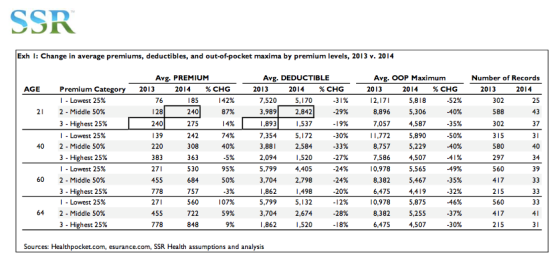
In Washington State, Obamacare will increase the underlying cost of individually purchased health insurance by 34-80 percent on average, according to Forbes.  The list goes on and on and includes Texas, Florida, New York, Illinois, Georgia and North Carolina.  But premiums are just the beginning.  The deductibles are outrageous, too.

A piece in Saturday’s The New York Times tells the story of Doug and Ginger Chapman, ages 55 and 54, a middle class couple “sitting on the health care cliff.”  Their annual income of around $100,000 a year makes them ineligible for a subsidy in New Hampshire (if they earned under $94,000, it would cut their costs by half). They have to replace their family insurance which includes the two of them and their two sons. The premium cost alone, not including any deductible is $1,000 a month, or 12 percent of their income. 
The Times’ analysis found the following:
“The cost of premiums for people who just miss qualifying for subsidies rises rapidly for people in their 50s and 60s. In some places, prices can quickly approach 20 percent of a person’s income. Experts consider health insurance unaffordable once it exceeds 10 percent of annual income. By that measure, a 50-year-old making $50,000 a year, or just above the qualifying limit for assistance, would find the cheapest available plan to be unaffordable in more than 170 counties around the country, ranging from Anchorage to Jackson, Miss.”
The other group that gets disproportionately hit is the young, according to Forbes.  For a 40 year old, the 2013 average deductible was $4,045, and the cost increased 29 percent to $309. For a 64-year-old man, the cost of a plan with a $3,494 deductible increased 64 percent to $806.
The Real Impact of Obamacare is Yet to Come
If even a fraction of the middle class and upper middle income earners divert some of their discretionary dollars to pay for health care, it will have a significant impact on consumer spending.  What will that mean for the economy? Consumer spending accounts for about 70 percent of the nation’s GDP, although experts say that number is likely to decline.
The top 20 percent of income earners account for about 40 percent of all spending in the U.S.  When you increase the costs of health care and the new taxes associated with Obamacare, you can hear the wallets closing. 

2012-09-18

ObamaCare: Can It Get Any Worse?


ObamaCare: Yet Another Government Time-Wasting Machine

 Posted 2012 September 18
IBD Editorial 

The Obama Record: The architects of our new health care regime have implied that their law will simplify the system. But political promises often have nothing in common with reality, and that appears to be the case here.
ObamaCare was retailed as a reform that would streamline health care services. One of the selling points of the legislation's capacity for untangling the administrative process was the introduction of electronic medical records.
President Obama himself said computerizing records would "cut waste" and "eliminate red tape."
How strange, then, that we learn that ObamaCare's paperwork and administrative requirements will require businesses and families to burn through 80 million man-hours a year.
Basing his assessment on data compiled by the Obama administration, former Internal Revenue Service Commissioner Fred Goldberg says that the "current form" of ObamaCare "will be a needless administrative and compliance quagmire for millions of Americans."
According to Ways and Means Committee Chairman Dave Camp, more than half of those 80 million man-hours will be consumed by small businesses — probably the group that can least afford to waste that much time.
"Every hour and dollar spent complying with the Democrats' health care law is time and resources being taken from growing a business, hiring new workers, or caring for patients," says Camp.
Don't even think about arguing that families and businesses' need to sift through ObamaCare's rules will stimulate hiring. The Tax Foundation says time spent on ObamaCare's administrative rules will "mostly" shift "employment from productive activities to unproductive activities, from the private sector to the public sector, and a general cluttering up of the tax code."The Tax Foundation has taken up the issue and notes that ObamaCare "will keep 40,000 people fully employed, filling out paperwork and sorting through a confounding pile of government regulations" and confirms that the work they will do "is entirely wasteful and creates zero wealth for America as a whole."
To give an idea of just how many hours will be squandered, Camp's office notes that in 80 million man-hours: the Empire State Building could be built 11 times over, the Curiosity rover could be flown from Earth to Mars 13,048 times and Halley's comet, which is visible only every 76 years, could be seen 119 times.
The troubles with ObamaCare continue to accumulate. The same week the Ways and Means Committee disclosed that the law isn't a time-saver after all, the Washington Examiner reported that it will likely cut franchisers' "profits in half overnight."
According to the Examiner, franchiser David Barr told the International Franchise Association last week that under ObamaCare franchisers' "only choice is to slash employee hours so they aren't eligible for company-paid health care or stop offering insurance and pay the $2,000 per employee fine."
Finally — at least for today — we also notice one other hidden flaw in ObamaCare that was uncovered last week: By taking $716 billion out of Medicare to use for ObamaCare, the administration "will produce deadly results," health-care analyst Betsy McCaughey writes for Fox News.
"Exhaustive data on over 2 million elderly patients treated at 208 California hospitals from 1999 to 2008 show that elderly patients treated in low-spending hospitals (bottom quintile) get less care and have a worse chance of surviving and leaving the hospital than elderly patients with the same diagnosis treated at higher spending hospitals," says McCaughey.
Yet again, the Democrats' promises about their health care overhaul are not only broken, they are entirely contrary to what is happening in real life.
Less red tape becomes a regulatory nightmare. Lower costs grow into stiffly higher expenses. Better care for seniors turns out to be more unnecessary deaths.
The country has been, to put it bluntly, deceived.

2012-08-29

The Federal Budget Solution


"The elementary truth is that the Great Depression was produced by government mismanagement [of money].  It was not produced by the failure of private enterprise." – Milton Friedman

The Ryan Budget: Confronting the Nation’s Spending Crisis

By Alison Acosta Fraser and Patrick Louis Knudsen
March 21, 2012
The Heritage Foundation
In the few months since Washington’s dramatic debt ceiling confrontation, America’s fiscal situation has only worsened. Federal spending is set to soar past previous record-shattering levels, endangering the economic future of the nation. This is a moral issue because younger generations will be forced to bear either staggering levels of debt or crushing taxes, or both. It is also a political challenge to this nation’s democracy as more and more Americans become dependent on government benefits while lawmakers seem unable to take decisive corrective action. The spending-driven debt crises of Greece and Italy are clear and compelling evidence that America must urgently change course. The only way to avoid a similar fate is to make bold, substantive changes in the size, scope, and purpose of the federal government.
Toward that goal, House Budget Committee chairman Paul Ryan (R–WI) has released a proposed federal budget resolution for fiscal year (FY) 2013 entitled The Path to Prosperity: A Blueprint for American Renewal. The plan lays out a comprehensive series of solutions to fix the nation’s twin crises of spending and debt. It rolls back the spending excesses of the past, tackles entitlement programs, makes defense a priority, and undertakes an important growth agenda to unleash America’s free enterprise system and get Americans back to work. This budget is not perfect; few consensus political documents can be. It should be bolder in implementing its entitlement reforms. It should strive for more aggressive spending reductions. It is slow to reach balance, largely the consequence of avoiding changes in Social Security and slowly phasing in health entitlement reforms. Still, this plan, like that passed by the House last year, substantially advances the serious and necessary conversation about securing America’s future and its legacy of freedom, opportunity, and self government.
Benchmarks for the Path to Prosperity
A budget contains many elements. It should provide a broad framework for spending and revenue priorities and for achieving balance. It must also set out at least thematically the fundamental policy reforms needed to achieve the fiscal objectives. A budget should be taken as a whole and measured in a comprehensive way—not by simply checking a series of boxes. Still, certain benchmarks can help guide the evaluation:
  • Does it begin decisive entitlement reform? The main sources of spending growth are the major entitlement programs: Medicare, Medicaid, and Social Security. Any serious budget should offer substantive proposals to improve benefits and make these programs sustainable and affordable in both the short term and the long term. This must include the repeal of Obamacare.
  • Does it cut spending sharply and quickly? Spending is the root of all other fiscal problems. So any budget should immediately and consistently rein in spending.
  • Does it avoid tax hikes? Raising taxes on American families, businesses, and investors is the wrong solution. Higher taxes slow the economy and cost jobs. Higher taxes also mean higher government spending.
  • Does it contain pro-growth tax reforms? Fixing the budget mess and ensuring a vibrant economy requires a strong growth agenda. A simpler, pro-growth tax code would result in greater economic freedom and faster growth. Faster growth generates more revenues—without tax hikes—and naturally lowers spending on safety net and anti-poverty programs.
  • Does it ensure a strong national defense? Defense is a core constitutional responsibility of the federal government, one that is necessary to preserve America’s liberty and prosperity. It should be fully funded. Cutting defense spending is not a responsible solution to getting spending under control.
  • Does it move swiftly to a balanced budget? The federal government should balance its budget by getting spending under control.
The best benchmark for measuring progress in fixing the budget mess is Heritage’s Saving the American Dream: The Heritage Plan to Fix the Debt, Cut Spending, and Restore Prosperity. The Heritage proposal features bold, sweeping changes to transform entitlement programs that guarantee America’s seniors economic security in retirement and reins in their costs to make them affordable. It has major spending reductions in other parts of the budget and ensures full funding for national defense. It also features a bold, new pro-growth tax reform plan.
The Ryan budget does not meet all the goals of Saving the American Dream, but it takes strong steps toward a number of them.
Entitlement Reform
Entitlements constitute nearly 60 percent of total federal spending, and their runaway growth—especially from Medicare, Medicaid, and Social Security—represents the greatest threat to the nation’s fiscal and economic health. The Ryan budget begins to tackle Medicare, Medicaid, and other anti-poverty programs.
The budget calls for immediate entitlement spending reductions of $18 billion in 2012–2013 and $331 billion over 10 years. These changes would be driven by the budget reconciliation process, with firm instructions to committees of jurisdiction to ensure that they really occur. About $70 billion of the reductions would go to partially offset automatic cuts known as “sequestration,” which would devastate national defense. The remaining spending reductions would come from changes to rein in longer-term entitlement spending—especially in the government’s health programs.
Obamacare. On health care, one of the most important policy changes in the Ryan budget is the repeal of Obamacare. Not only does Obamacare add trillions in new spending and billions in tax hikes that the country cannot afford; it expands on a failed price-control model for Medicare, massively broadens a broken Medicaid program, and introduces a new subsidy scheme that is financially unsustainable.
Medicare. The House budget would transition the current Medicare program into premium support beginning in 2023. Premium support provides seniors with defined financial contributions from the government to apply to health care plans that they choose for themselves, in contrast to one-size-fits-all, government-funded, government-regulated, and government-controlled health care. Plan options would include traditional Medicare and would compete alongside private health plans in a market called the “Medicare Exchange.” The government contribution would be based on a competitive bidding process. A senior could choose a more expensive health plan than the government contribution but would have to pay the difference.
The government’s defined contribution in Medicare would be further adjusted by income, geography, and risk. For example, upper-income seniors would pay more than the standard premium, and lower-income recipients would qualify for additional assistance. Additionally, high-risk beneficiaries would secure greater payments to offset their higher costs, and a risk-adjustment mechanism would guarantee sicker Medicare patients access to medical care—and ensure continued plan participation and market stability in the new program. The market-based bidding and requirements that Medicare compete head-to-head with private plans for patients’ dollars closely resembles Heritage’s plan in Saving the American Dream.
Most experts agree that competition in health care would control costs. But to assure budgetary savings, the Ryan budget includes a cap on Medicare spending at the growth of gross domestic product (GDP) plus 0.5 percent. The budget also includes process reforms that disclose long-term unfunded liabilities, forcing Congress to confront their growing costs. It also establishes mechanisms for controlling longer-term costs of entitlement programs, taking them off budgetary autopilot. At the same time, the Ryan budget calls for repealing Obamacare’s rationing panel, the Independent Payment Advisory Board, which is important to do within the full repeal of Obamacare.
Medicaid. The Ryan budget replaces the open-ended financing arrangement with a fixed federal contribution to the states. In addition, the proposal offers states greater flexibility in designing their programs to better help those in need.
Putting Medicaid on a budget is a critical first step to fundamentally reforming Medicaid. The next step should be to help mothers and children out of the poorly performing Medicaid program and give them access and assistance to purchase private health insurance options while working with the states to develop a more patient-centered safety net for the poor elderly and those with disabilities.
Other Health Care. Elsewhere on the issue of health care, the Ryan budget notes the current tax treatment of health insurance, creates a variety of distortions in the marketplace, and recommends steps to address these flaws. Ideally, changes to the tax treatment of health insurance would replace the current tax structure with individual tax relief that helps consumers buy their own policies. This tax change is critical in moving toward a patient-centered, market-driven health care system.
Entitlements: What Is Missing
The Ryan budget’s effort to advance entitlement reform should be stronger. Implementation of Medicare premium support is delayed for 10 years—“grandfathering the grandparents,” as Ryan puts it. This is one of the principal reasons the budget does not balance in the coming 10 years.
In addition, the budget contains no Social Security reforms, resorting instead to a mechanism that would trigger reforms. It does not include basic steps to rein in the cost of Social Security, such as gradually raising the retirement age or using a more realistic measure for cost-of-living increases. Such changes would be important steps to shoring up Social Security’s finances.
Growth-Oriented Tax Reform—Not Tax Hikes
The root of the government’s deficit problem is excess spending, not a lack of revenue. The budget resolution recognizes that the economy cannot withstand the impact of impending tax hikes at the end of this year and stops the mammoth job-killing, anti-growth tax increases coming on January 1, 2013.
Instead, the budget resolution reduces the highest-in-the-world corporate tax rate from 35 percent to 25 percent and reduces the top individual income rate to the same level. The lower corporate tax rate would reverse the flow of jobs to foreign countries, and the lower individual income tax rate would improve incentives for workers and businesses to produce more and for investors and businesses to create new jobs.
Other positive features of the tax plan include abolition of the Alternative Minimum Tax and a move to a territorial business tax in place of our worldwide system. This kind of growth-oriented tax plan would help promote a stronger economy along with more wage and job growth.
The proposed tax reforms would have been far stronger, however, had they eliminated taxes on capital gains, dividends, and the death tax.
Defense
A strong national defense is both a key responsibility of the federal government under the Constitution and essential to protecting Americans’ liberties. As such, Ryan is certainly correct that America needs “a military that keeps America safe by letting national strategic priorities determine spending levels, not the other way around.” However, Ryan’s budget restores only about half the core defense funding cuts proposed by President Obama’s over a 10-year period.
Congress needs to recognize that covering the full cost of the overseas contingency operations, including “resetting” the force drained by a decade of combat, will require funding that extends long beyond the end of the operations themselves.
Ryan’s budget proposal takes some but not enough steps to begin to address the most immediate threat to maintaining the nation’s military capabilities. This is the threat of the “sequestration” provision for defense in last year’s Budget Control Act. President Obama, by contrast, proposes to make defense the lowest budget priority of the federal government by later this decade and threatens to veto bills that defer defense sequestration.
The Numbers
When its collection of policies is boiled down to the numbers, the Ryan plan reduces budget deficits from $1.2 trillion this year (7.6 percent of GDP) to $166 billion (0.8 percent of GDP) in 2018, after which they tick up again to $287 billion (1.2 percent of GDP) in 2022. The budget begins to stabilize debt, reducing debt held by the public from 73.2 percent of GDP now to 62.3 percent in 2022.
The budget also proposes caps on total spending and on major categories of spending and requires periodic reviews of entitlement programs to take them off autopilot spending. The critical point, after all, is to reduce spending, which drives all other fiscal problems. Over the long term, the budget brings spending down from its unsustainably high level of 23.4 percent of GDP this year to 19.3 percent in 2018. Spending then edges back upward as more baby boomers retire—reaching 19.8 percent of GDP in 2022—but remains below 20 percent (the average of the past 50 years). By 2040, spending is down to 18.75 percent of GDP. As noted earlier, “grandfathering the grandparents” and not tackling Social Security makes it much more difficult to reduce spending more and thus balance the budget before the late 2030s.
The budget holds non-war discretionary spending in 2013 to $1.028 trillion, $19 billion below the Budget Control Act ceiling and $15 billion below the 2012 limit—which, if enacted by appropriations bills, would be a real cut from prior year spending.
The Big Picture
Cutting spending is requisite to solving the nation’s budget crisis. But setting numbers alone will not get the job done. Instead, each one of the elements described above is an integral component to a transformative budget. Ryan’s budget, and any other budget, should be evaluated on how well it delivers on all these elements together. Ryan’s budget takes strong strides in the right direction. It cuts spending, in the budget year and into the future—from both discretionary and mandatory accounts—provides substantive entitlement reforms, and avoids tax hikes. It also outlines a tax reform that would strengthen the economy and by implication further strengthen government finances through stronger economic growth.
There is a great deal more work to do, as the Heritage plan Saving the American Dream reflects. Nevertheless, the Ryan budget represents real progress toward tackling the nation’s fiscal and economic challenges. But this progress will become reality only if Congress follows through with legislation that delivers these kinds of strong policy changes.
Alison Acosta Fraser is Director of and Patrick Louis Knudsen is the Grover M. Hermann Fellow in Federal Budgetary Affairs in the Thomas A. Roe Institute for Economic Policy Studies at The Heritage Foundation. Nina Owcharenko, Curtis Dubay, and Baker Spring also contributed to this report.

2012-08-24

Fix Healthcare in the U.S.

Healthcare in the U.S. is a train wreck in motion!

American's For Tax Reform (ATR) believes that individuals should control America's healthcare system, making informed health decisions with their own money and chosen healthcare experts.

ATR believes that America’s healthcare system should be controlled by individuals, not by third party payers like governments or insurance companies. People should be in charge of making informed health decisions with their own money and in consultation with their chosen healthcare experts. Insurance should be reserved for catastrophic health events, much like car insurance is reserved for catastrophic automobile events. The best type of insurance is a high-deductible health insurance plan in conjunction with a health savings account (HSA).

Healthcare Taxes
ATR believes that the tax treatment of health insurance should be neutral, no matter whether you get health insurance from an employer or on your own. That’s why we believe in expanded health savings accounts (HSAs) with higher contribution limits and the ability to pay for health insurance premiums with pre-tax dollars. We believe that flexible spending accounts (FSAs, or “flex plans”) should work more like HSAs. We believe that you should be able to purchase health insurance across state lines. We believe that trial lawyers should not be able to drive up the cost of care with lawsuits. In general, healthcare markets can and should work like any other market to provide efficient services and goods to savvy consumers.

Obamacare
ATR opposes Obamacare principally because it created two dozen new or higher taxes. These tax increases include a higher capital gains and dividends tax, various new taxes on health insurance plans, taxes on FSAs and HSAs, a “medicine cabinet” tax, a new tax on medical device manufacturers, a “Cadillac plan” excise tax on health premiums, an individual health insurance mandate, an employer health insurance mandate, and many others.

HSA/FSA
Tax-free savings accounts allow consumers to be empowered to purchase healthcare services themselves, without governments or insurance companies interfering. They are an essential tool in moving toward a consumer-driven healthcare system that puts patients in charge, not government or corporate bureaucrats. HSAs, in particular, have proven effective at bringing down cost inflation, saving for future healthcare needs, and empowering families. A flexible spending account or “flex-plan” (FSA) is a “use it or lose it” account which ATR believes should work more like HSAs.

2012-08-20

How Socialized Medicine Doesn't Work


Not A Single Patient Benefits From A Single-Payer Program


Vermont is trying to implement a single-payer system by itself. This month, Green Mountain State officials will actually dictate how much hospitals can raise spending in the coming year. At the national level, Rep. Jim Mc-Dermott, D-Wash., has introduced legislation that would allow states to use federal funding to implement their own single-payer programs.

Some health policy wonks have expressed their sympathies for such a system.

While reflecting on the paean to Britain’s single-payer system that was part of the Opening Ceremonies at the London Olympics, Princeton economics professor Uwe Reinhardt noted that Americans “have long reserved for our veterans the purest form of socialized medicine, the vast health system operated by the U.S. Department of Veterans Affairs.”

Perhaps that’s a system that all Americans would want? Not likely.

Single-payer systems—without fail—saddle patients with long wait times for vital treatments, low-quality care, and reduced access to basic medical services.

A new report from Canada’s Fraser Institute makes that even clearer.

Researchers found that the median wait time from seeing a specialist to getting treatment is now 9.5 weeks, up from 9.3 weeks in 2010. By the end of 2011, over 941,000 of my former countrymen were waiting for medical treatment.

Over the last two decades, wait times for specialists have more than doubled.

Fraser also surveyed physicians operating in 12 specialties across 10 provinces and found that the average time between a referral from a general practitioner and the actual administration of an elective procedure is now 19 weeks — the longest ever recorded.

“Physicians themselves believe that Canadians wait nearly three weeks longer than what they consider is clinically ‘reasonable’ for elective treatment,” researchers said.

Some Canadians have decided that enough is enough — and have traveled to the United States to get treatment. More than 46,000 did so last year, according to Fraser.
Canada’s healthcare system does not stand alone as a government-run failure.

Britain’s Royal National Institute of Blind People just released data showing that over half of the local trusts that make up the National Health Service have created “very restrictive” standards for cataract operations.

Tougher treatment criteria have led to longer wait times for people suffering from cataracts. These cloudy patches on the lens of the eye can cause blindness if left untreated.

Prof. Harminder Dua, president of The Royal College of Ophthalmologists, has called these tougher standards “arbitrary” and “a response to financial pressures, not clinical needs.”

Amazingly, the British government acknowledges it deprives its subjects of the best treatment. According to the government’s National Radiotherapy Implementation Group, one-third of cancer patients are not offered the latest in cancer treatment technology, which uses precision-targeted radiation to kill cancer cells.

These brutal realities should prompt pause from Americans who seem to believe that health care is better beyond U.S. borders. Unfortunately, Obamacare is pushing the U.S. to emulate the government systems common abroad.

Work published in Health Affairs puts the government health care tab at an astonishing $4.6 trillion at the end of this decade. That’s about a fifth of the American economy. Today, that number is $2.6 trillion — or almost 18% of GDP.

By 2020, the government will spend one of every two health care dollars in this country.

And it’s not just the outsized share of spending that the government is set to take on. Obamacare will dictate how the rest of the health care market is to function — controlling what it doesn’t directly pay for.

Look to Obamacare’s model — the 2006 Massachusetts health reform plan — for a preview of how. On Aug. 6, Gov. Deval Patrick signed legislation that would forcibly limit the growth of health spending to the rate of economic growth in the Bay State through 2017.

Between 2018 and 2023, health spending growth would be capped at a rate 0.5 percentage points less than economic growth. The measure’s backers project savings of $200 billion over 15 years.

Insurers and large hospitals in Massachusetts will also have to pay $225 million in surcharges over four years, starting in 2013. To enforce these targets, the new law establishes a commission that can impose $500,000 fines on organizations that don’t appear to be playing ball.

Price controls like these will yield the same result they have in foreign single-payer systems — a reduction in the availability of care.

Government does not yet control health care entirely in the U.S. But Obamacare hastens that process — apparently ignorant of the failure of government-run systems elsewhere.

Pipes is president, CEO, and Taube Fellow in Health Care Studies at the Pacific Research Institute. Her latest book is “The Pipes Plan: The Top Ten Ways to Dismantle and Replace Obamacare” (Regnery 2012).

2012-08-19

Ryan's Plan for Market Medicine


Why The Paul Ryan Plan Might Be Right About Medicare


By ROBERT J. SAMUELSON
Posted 08/17/2012 06:29 PM ET
Investors Business Daily
Overlooked in the furor surrounding Paul Ryan's Medicare proposal — a plan that wouldn't start until 2023 and even then would affect only new beneficiaries — is a just-published study in the Journal of the American Medical Association (JAMA) suggesting that, well, Ryan might be right. The study finds that a voucher-type system might noticeably reduce costs compared with traditional fee-for-service Medicare.
Three Harvard economists, including a prominent fan of the Obama health care overhaul, did the study.
The study compared the costs of traditional Medicare with Medicare Advantage, a voucherlike program that now enrolls about 25% of beneficiaries. Medicare Advantage has cost less for identical coverage. From 2006 to 2009, the gap averaged 11% between traditional Medicare and voucher plans that, under the proposal by Ryan, would serve as a price benchmark.
The central issue here is whether the runaway cost of the health sector, comprising nearly one-fifth of the economy, can be controlled without eroding medical quality. Almost all agree that the delivery system — hospitals, clinics, doctors and nurses — should be reorganized to lower the price and eliminate unneeded care. The question is how.
One group favors marketlike mechanisms. Consumers would receive vouchers — payments or tax credits — to buy coverage. The theory: As people shop for low-cost and high-quality plans, competition forces the delivery system to restructure. Hospitals, doctors, insurers create more efficient networks with more coordinated care than today's fee-for-service system.
By contrast, fee-for-service reimburses doctors and hospitals for services they perform; this encourages unneeded tests and procedures.
The JAMA study doesn't surprise consumer-driven health care advocates. "Medicare fee-for-service is an inefficient way to deliver care," says James Capretta, associate director of the Office of Management and Budget from 2001 to 2004. "It's an engine for volume-driven spending."
Cost savings under a full-fledged voucher system would be much larger, he argues, because Medicare Advantage's modest size has created only "muted competition."
Medicare Advantage reinforces another bit of real-word evidence for marketlike policies. This is the Medicare drug benefit launched in 2006 with a voucher approach. In 2012, beneficiaries could choose from at least two-dozen plans. Its costs have been about 30% below early government estimates, though vouchers are not the only reason (more generic drugs is another). In 2013, average monthly premiums — paid by recipients — are projected to stay at $30 for a third straight year.
The other way to control costs is regulation, as embodied in the Affordable Care Act (ACA). One argument for this is that cost savings from vouchers are a statistical mirage. Harvard health economist David Cutler — a co-author of the JAMA study and an outspoken supporter of the ACA — thinks this is possible. Medicare Advantage's lower costs might stem mostly from healthier patients, who use fewer services. It's unclear that statistical "risk adjustments" eliminate all these differences, he says.
Lower reimbursement rates are the most common form of cost regulation. The ACA cuts $700 billion from Medicare over a decade by slashing payment rates. But reimbursement cuts don't change the delivery system. Providers often react by increasing the volume of services; the system becomes more wasteful. (The Medicare cuts don't actually reduce health spending; they just transfer funds from Medicare to spending mandated by the ACA.)
The rest of the ACA's cost controls are mostly fluff. One idea is accountable care organizations (ACOs), which link payment to better coordination of medical treatment. The administration says its ACO proposal might save $470 million from 2012 to 2015, when projected Medicare spending exceeds $2 trillion; savings would be a rounding error.
Then there's the Independent Payment Advisory Board, a body of 15 experts who limit Medicare spending if it passes certain targets. But the law handcuffs IPAB. It can't increase patient cost-sharing, restrict benefits, modify eligibility requirements or — in any one year — cut spending by more than 1.5%.
Limits must be imposed on the health sector, and the growing evidence from large-scale experience is that market mechanisms offer the best chance of reconciling our desire for choice with cost control. If there are better ideas, let's hear them. Otherwise, don't reject the obvious because it's unfamiliar.
Voucher plans are not right-wing, extremist ideas. They enjoy support in both parties. Ryan would permit continuation of fee-for-service; if it's more efficient and effective, it would survive. If not, its decline would be no great loss. The Ryan plan's greatest defect may be that it doesn't start for a decade. We can't wait that long.

2012-06-14

Market Medicine NOT ObamaCare


No Need For ObamaCare If Providers Are Liberated


By CHARLES J. WILLEY
Posted 06/13/2012
We continue to read with dismay about the adverse effects of ObamaCare ... the crafty way it was passed, the 2,700-page bill no one read, the "Cornhusker Kickback" and other secret deals, the hidden regulation and costs. Now our fears about the bill are reality.
The Department of Health and Human Services has generated thousands of more pages of regulation. Even the government admits ObamaCare will cost at least twice its estimates and will increase health care costs by $2,000 annually per family. Many will not keep their current insurance and doctors.
Practicing doctors, who know best how to care for patients most cost effectively, are still today left out of the health care debate . .. a small voice among powerful lobbyists, politicians and regulators. Doctors are particularly skeptical about ObamaCare: 90% say premiums will go up; 70% say it will drive the best and brightest out of the profession; 65% say quality of care for their patients will decline. I am one of those doctors who fears for my patients' future care.
Real health care reform is possible and necessary. But it won't come from government regulation dictating methods of practice and health insurance purchase requirements. Over-reaching regulation depersonalizes patients and dissociates them from its demoralized doctors, favors hospitals that can manipulate the system, guarantees profit for giant insurance companies without regard to health outcome, and disenfranchises patients from authority over, and responsibility for, their own health and its costs.
Real health care reform comes from eliminating the misguided rules and incentives created by government and other interlopers into the patient-doctor covenant.
The high cost and limited access in our current system is caused by government. Here are a few examples:
Medicare currently pays hospitals two to four times more than a nonhospital vendor for the exact same stress test or MRI.
Government bans physician-owned specialty hospitals, such as orthopedic surgery centers, forever relegating joint replacement to be performed in the same high-cost operating suites as those used for cases involving puss, risking devastating prosthesis infection.
Doctors and nurses spend more time on regulatory paperwork than patient care. There is no patient-centered rationale for this regulation. In fact, these policies deny choices, diminish care, and increase costs.
The effect on my profession has been catastrophic. Doctors now need to function like lawyers if they care for Medicare patients, complying with thousands of regulations that no one understands, under threat of criminal penalties.
Many run for cover to hospital employment, whose expertise has sadly evolved to managing regulation to advantage every next government incentive. The results: soaring costs while individualized patient care suffers.
Real health care reform should encourage practice models (and their coordinated financing plans) that combine clinical and economic responsibility with our long-term patient relationship. We know this practice model works.
For 30 years, I've led physician groups who care for populations of seniors — with higher than average illness burden — at much lower than average total cost of care, with better outcomes.
I presently care for a regular Medicare population with quality rankings above 90% on six of seven measures. For an 11% higher illness burden, my total cost of care is 72% lower than average (CMS Quality and Resource Use Report, March 2, 2012).
I also provide superior care for 1,000 Medicare Advantage members, whose illness burden, quality and satisfaction scores are even higher, under a richer benefit plan than Medicare, at a cost of care which is 50% less than average.
If all Medicare beneficiaries were cared for under this model, Medicare could be administered for $290 billion annually instead of its current $580 billion, saving $2.9 trillion in 10 years, without any cuts, serving healthier, happier seniors.
Our practice model lowers cost by achieving lasting population health that finances a rich benefit plan so patients can afford recommended care, resulting in high patient satisfaction. We intervene early and often, minimizing the misery and costs of catastrophic illness.
We transfer a manageable portion of the risk for cost-of-care to the patients in the form of copayments, creating a meaningful short-term economic incentive to be healthy and respect their fiduciary duty to the health risk transfer pool.
We schedule fewer patients for longer well-placed visits, treat more patient situations ourselves, and work closely to lead specialists and hospitals to high quality, efficient care of patients. We use information technology to anticipate population care needs, rather than waiting for patients to become sick, avoiding the 'systems failure' of an emergency room visit.
We aggressively promote wellness through leadership and coaching, even paying YMCA membership fees helping seniors exercise and socialize. Many other medical groups use this model with similar quality, access, and low cost.
We don't need to reduce quality and access to care or create a massive government-mandated system to improve our health care. These do not benefit patient care, access, or cost. Medical groups know that we just need an environment that is free of ObamaCare and liberated from the pre-ObamaCare regulations that exist only to protect well-entrenched fiefdoms currently controlling health care.
Historically, we know that free markets provide free societies with competitive pricing, improved access for all, and greater innovation. They can do the same for health care. Restoring free markets with the advantages of information technology can redefine the existing strained patient-doctor covenant for the best result: high quality, low cost, long-term health for all.
The new scrutiny of the patient (the customer) armed with the bright light of information technology will greatly diminish the need for government regulation. We must liberate health care providers to innovate, compete and be rewarded not only on quality care for patients, but also on their performance and costs in achieving long-term population health.
Doing so will improve long-term citizen health and access to care, and reverse rising health care costs. The solution hides in strategically reducing government's role in health care.
This modest model solution already exists; it just needs room to breathe.
• Willey, an internist, is the founding CEO of several medical groups and a Medicare Advantage health plan, currently practicing with six physicians and five nurse practitioners as Innovare Health Advocates in St. Louis.

2012-05-12

How To Fix Healthcare in America


Dr. Lee Hieb
Lee Hieb is an Orthopaedic Surgeon, in solo private practice.
Her first-hand experience in medicine began in the 1950s,
when she accompanied her father on his housecalls in Iowa.
When this law is in full force, individuals cannot choose to
self insure, no matter how much they may be able to
afford to do so.
Obama used the AMA's endorsement to claim "doctors"
support his health care takeover. But that's not accurate.
Government-pay medicine cannot be moral medicine.
Obama's recent claim on doctors' payment is inaccurate
and seems to demonize doctors.
After working as a highly trained spinal surgeon for
five years, I realized I could not get financially ahead.
From 130,000 pages of Medicare regulations to a new
Twilight Zone health care plan...
Lack of medevac and shock-trauma treatment in
government-run medicine may have played a part in the tragedy.
Why did Obama win? Because most Americans do not
understand the system that feeds them...
Does Obama think Tom and the boys accidentally left
that one out of the Constitution?
In a democracy, we do not shoot our "class enemies"
-- we label them "rich" and tax them out of productivity.